
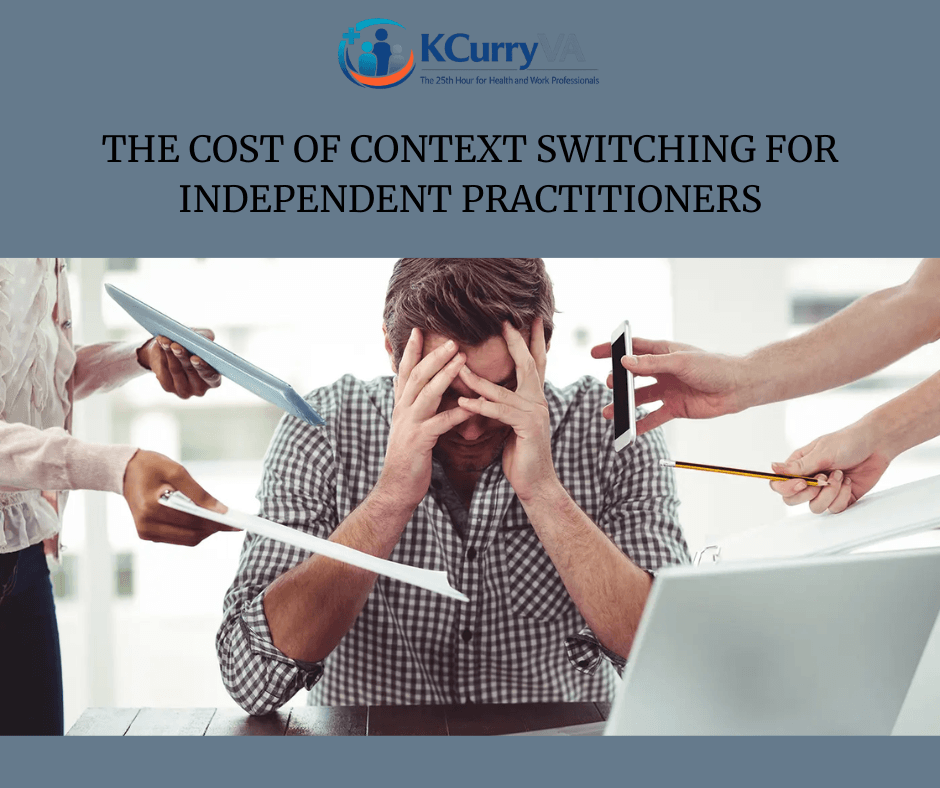
Why constantly switching between clinical work and administration costs more than you think
You sit down to write a report.
Then an email arrives.
You quickly reply.
While you’re there, you notice another message that needs answering.
You check your calendar.
A client has requested a change to their appointment.
You make the adjustment.
Then you remember you were halfway through arranging something with an employer.
You find the email.
Reply.
And finally, you return to the report.
Except now you have to remember where you were.
This might feel like a normal working day.
For many independent health and work professionals, it is.
The problem is that none of those interruptions feels significant enough to worry about individually.
But collectively, they can have a considerable impact on your time, attention and mental capacity.
This is context switching: repeatedly moving your attention between different tasks, types of information or areas of responsibility.
And when your work already requires concentration, clinical reasoning and complex decision-making, the cost can be much greater than the few minutes each interruption appears to take.
In this Article
Key Takeaways
- Context switching costs more than the time spent on the interruption itself.
- Frequent switching can fragment attention and make cognitively demanding work harder to complete.
- Independent practitioners often switch between professional, administrative and business responsibilities throughout the same day.
- Reducing unnecessary switching is about improving how work is organised, not simply becoming more disciplined.
- Protecting uninterrupted thinking time can create more capacity without increasing your working hours.
What Is Context Switching?
Context switching happens when you move your attention from one task to another.
Some switching is unavoidable.
A client may need urgent attention.
A safeguarding concern may require immediate action.
A genuinely time-sensitive issue may need to take priority.
The problem is unnecessary switching.
Moving from report writing to email because a notification appeared.
Stopping a client-related task to rearrange an appointment.
Switching from professional work to invoicing, then returning to a complex case.
Moving between multiple systems simply to find the information you need.
Each transition requires your attention to disengage from one task and reorient towards another.
Then, when you return to the original task, you need to reconstruct your focus.
That process takes mental effort.
Why Independent Practitioners Are Particularly Vulnerable
Working independently gives you freedom.
It also means you’re often responsible for almost everything.
You may be:
- delivering client work
- writing reports
- managing your diary
- answering enquiries
- communicating with employers
- liaising with insurers
- completing accounts
- managing your website
- marketing your services
- organising professional development
These activities require very different types of attention.
Clinical reasoning requires depth.
Administrative tasks often require speed and responsiveness.
Business development requires strategic thinking.
Moving repeatedly between these modes throughout the day creates a fragmented working pattern.
You’re not simply doing more tasks.
You’re continually asking your brain to change gears.
The Hidden Cost of a “Quick” Task
One of the biggest problems with context switching is that the interruption rarely ends when the task does.
Imagine you’re writing a complex report.
You receive an email that takes three minutes to answer.
Three minutes doesn’t sound significant.
But the cost isn’t necessarily three minutes.
You also need to:
- Stop what you’re doing.
- Read and interpret the email.
- Decide whether it needs a response.
- Formulate the response.
- Send it.
- Remember what you were doing.
- Reconstruct your train of thought.
- Re-engage with the report.
The interruption has therefore consumed both time and attention.
Multiply that across a working day and the cumulative impact becomes much more significant.
Not All Work Requires the Same Kind of Attention
This is particularly important for health and work professionals.
Some tasks require relatively little cognitive effort.
Others require sustained concentration.
Writing a defensible report isn’t the same as confirming an appointment.
Analysing a complex case isn’t the same as filing a document.
Developing a return-to-work recommendation isn’t the same as responding to a routine email.
Yet when these activities are mixed together throughout the day, the practitioner has to repeatedly move between different cognitive demands.
The result can be a day that feels extremely busy without producing the amount of meaningful work you’d expect.
How Context Switching Shows Up in Practice
You may recognise some of these patterns:
“I’ll just quickly check my emails.”
A five-minute check becomes twenty minutes of responding, forwarding and following up.
“I’ll finish this report later.”
The report gets repeatedly interrupted by smaller tasks that feel more urgent.
“I can’t concentrate today.”
The problem may not be your concentration.
Your attention may simply have been fragmented repeatedly.
“I was productive all day, but I didn’t get the important things done.”
Activity isn’t necessarily progress.
If your day is dominated by reacting to whatever appears next, important work can continually be pushed aside.
Five Ways to Reduce Unnecessary Context Switching
1. Batch Similar Tasks Together
Instead of responding to every email as it arrives, consider creating specific communication periods.
The same principle can apply to:
- telephone calls
- routine administration
- invoicing
- document filing
- diary management
Grouping similar activities reduces the number of times you have to change mental mode.
2. Protect Deep Work
Identify the work that requires your greatest concentration.
For many practitioners, that might include:
- report writing
- complex case analysis
- assessment preparation
- clinical documentation
- business planning
Where possible, give these activities protected periods without routine interruptions.
Your most cognitively demanding work deserves your best attention.
3. Reduce Notifications
Every notification creates a potential interruption.
Consider whether you really need immediate notifications from:
- messaging platforms
- project management systems
- social media
- other applications
Not every incoming message deserves immediate access to your attention.
4. Create Clear Workflows
A defined workflow reduces the number of decisions you have to make about what happens next.
For example:
Information received → review → action recorded → follow-up scheduled → task completed
The clearer the process, the less mental effort is required to manage it.
5. Separate Professional and Operational Work Where Possible
If your day allows it, avoid constantly moving between client-facing work and administrative tasks.
That might mean:
Morning: client work and complex professional tasks
Afternoon: reports, communication and administration
Or simply creating protected blocks within the same day.
There isn’t one correct structure.
The principle is to reduce unnecessary movement between different types of work.
What About Urgent Work?
Of course, not everything can be batched.
Health and work professionals sometimes deal with genuinely urgent situations.
The answer isn’t to become rigid.
It’s to distinguish between urgent and available.
An email appearing in your inbox doesn’t automatically make it urgent.
A diary notification doesn’t necessarily require immediate action.
A task being visible doesn’t mean it needs to interrupt what you’re currently doing.
Creating clearer criteria for what deserves an interruption can protect attention without compromising responsiveness.
Questions to Ask About Your Own Working Day
Take a moment to think about yesterday.
How many times did you move between:
- client work and email?
- reports and administration?
- professional work and business management?
- one client or case and another?
- one system and another?
Then ask yourself:
- Which interruptions were genuinely necessary?
- Which could have waited?
- Which tasks could have been batched?
- Where do I need uninterrupted thinking time?
- What repeatedly pulls me away from high-value work?
You may discover that your biggest problem isn’t the volume of work.
It’s the way that work is arranged.
From Constant Switching to Intentional Working
The aim isn’t to eliminate every interruption.
That’s unrealistic.
The aim is to create enough structure that your attention isn’t constantly being redirected by relatively low-value tasks.
This might involve:
- clearer workflows
- better task management
- communication boundaries
- protected focus time
- standardised processes
- delegated administrative responsibilities
The right solution will depend on the practice.
But the underlying principle remains the same:
Your attention is a finite resource. Treat it as one.
A Final Thought
Independent practice gives you control over how you work.
But without deliberate boundaries and systems, that freedom can easily become a working day where everything competes for your attention.
Client work.
Emails.
Reports.
Administration.
Business development.
Appointments.
Follow-ups.
All demanding something from you at the same time.
The result isn’t necessarily that you’re doing too much.
It’s that you’re switching too often.
And when your most valuable work requires concentration, that matters.
You don’t necessarily need to work longer.
You may need to protect your attention better.
Because creating capacity isn’t always about finding more time.
Sometimes it’s about allowing the time you already have to be used with greater focus.
About KCurryVA
KCurryVA provides specialist operational support for health and work professionals, including case managers, vocational rehabilitation providers, occupational therapists and independent practitioners. Through administrative, operational and project support, I help clients reduce operational friction, protect valuable fee-earning time and create clearer, calmer and more sustainable ways of working.