
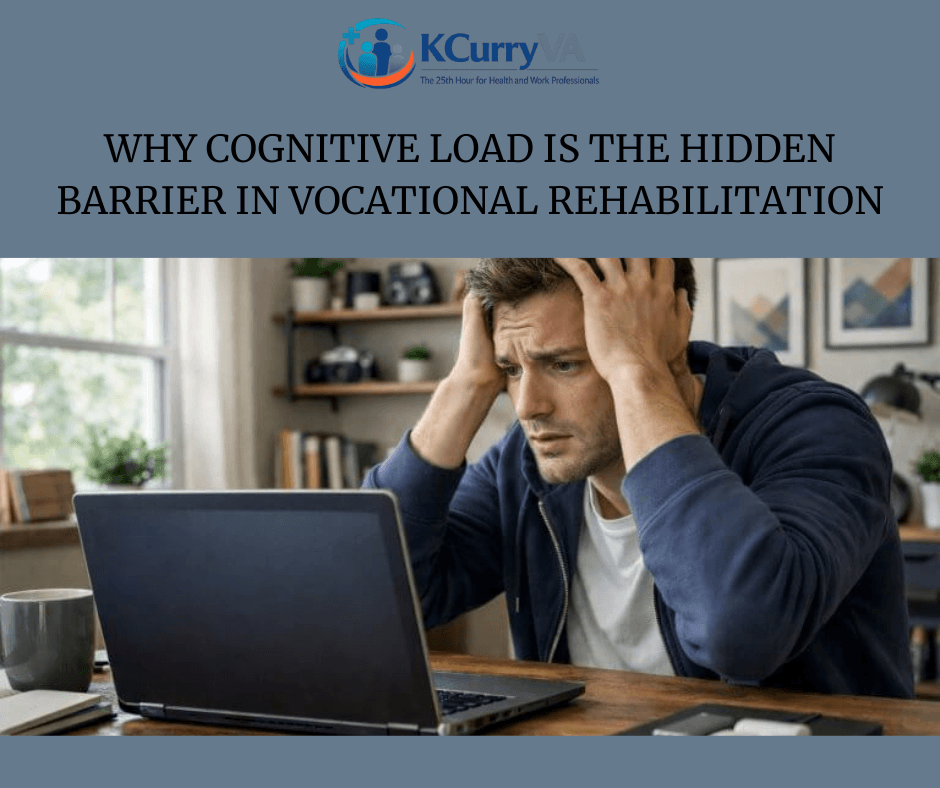
The mental workload affecting clinical reasoning, practitioner wellbeing and return-to-work outcomes
Vocational rehabilitation professionals rarely struggle because the work itself is difficult.
More often, the challenge lies in carrying the mental weight of dozens of unfinished decisions at the same time.
A case manager might begin the morning reviewing a functional capacity report, move to an employer meeting, respond to insurer queries, coordinate multidisciplinary input, rearrange appointments and finish the day drafting recommendations—all while keeping multiple complex cases active in their mind.
That isn’t simply a busy workload.
It’s cognitive load.
And it may be one of the most overlooked barriers to effective vocational rehabilitation practice.
It is often not the work itself that overwhelms vocational rehabilitation professionals; it is the thinking about the work. For case managers, occupational therapists, physiotherapists and vocational rehabilitation practitioners, the day rarely unfolds in a straight line. Instead, it becomes a continual mental juggling act: holding multiple cases in mind, drafting reports, liaising with employers, coordinating multidisciplinary input and navigating the emotional complexity of supporting people whose lives have been disrupted by illness or injury.
What appears to be “busy work” from the outside is, in reality, a constant cognitive negotiation.
Recent UK evidence shows that burnout is widespread across healthcare professions, driven by chronic workload, increasing complexity and organisational pressures. The House of Commons Health and Social Care Committee described burnout as a “widespread reality” across the NHS, highlighting that the discretionary effort which has kept the system functioning for years is no longer sustainable. Their report concludes that protecting staff wellbeing is essential to maintaining the quality and safety of care.
Research from Birkbeck, University of London similarly found that more than a third of NHS staff reported experiencing burnout, with poor mental health becoming one of the leading causes of sickness absence across the service.
Although much vocational rehabilitation work takes place outside the NHS, the cognitive pressures are strikingly similar and are often intensified by fragmented systems, multiple stakeholders and complex return-to-work pathways.
Against this backdrop, cognitive load becomes far more than a productivity issue.
It influences clinical reasoning, report quality, communication, decision-making and ultimately the outcomes achieved for the people we support.
Table of Contents
Key takeaways
- Cognitive load is about mental bandwidth, not simply workload.
- Vocational rehabilitation professionals manage exceptionally high levels of cognitive complexity.
- Excessive cognitive load can affect decision-making, communication and clinical confidence.
- Reducing operational friction protects both practitioner wellbeing and client outcomes.
Understanding cognitive load in plain language
Cognitive load simply refers to the amount of mental effort required to think, process information and make decisions.
Every day, vocational rehabilitation professionals are required to absorb new information, interpret complex situations and make numerous clinical judgements.
Working memory, the brain’s short-term processing space, has limited capacity. As more demands compete for that capacity, performance gradually declines.
Alongside this are other well-recognised cognitive pressures:
- Decision fatigue from making countless small judgements throughout the day.
- Context switching between clients, employers, insurers and multidisciplinary teams.
- Unfinished tasks occupying mental attention long after the working day has ended.
- Constant interruptions from emails, telephone calls and urgent requests.
Each of these may seem manageable in isolation.
Together, they create cognitive friction that quietly erodes clarity, confidence and capacity.
Why vocational rehabilitation professionals are particularly vulnerable
Vocational rehabilitation is cognitively demanding by its very nature.
Unlike many clinical roles, practitioners must integrate medical information with workplace realities, legal considerations, psychosocial factors and employer expectations.
Cases are rarely straightforward.
Information is often incomplete.
Recommendations must balance competing priorities while remaining evidence-based and defensible.
Several factors increase cognitive load within vocational rehabilitation:
- High case complexity
- Multiple stakeholders
- Fragmented information systems
- Frequent context switching
- Emotional labour
- Pressure to produce clear, defensible documentation
The House of Commons report identified excessive workload, fragmented systems and organisational pressures as major contributors to burnout across health and social care.
Vocational rehabilitation professionals often experience many of these same operational challenges.
How cognitive overload shows up in practice
Cognitive overload rarely arrives suddenly.
Instead, it develops gradually and often goes unnoticed until its effects become difficult to ignore.
You may notice:
- Reports take longer to write.
- Clinical reasoning feels less clear.
- Important details are harder to hold in mind.
- Emails require repeated reading.
- Decisions take longer than they once did.
- You begin feeling mentally scattered despite being constantly busy.
- Complex tasks are postponed because they simply feel too mentally demanding.
These are not signs of incompetence.
They are often signs that your cognitive capacity has reached its limit.
The impact on return-to-work outcomes
High cognitive load doesn’t only affect practitioners.
It also affects the people they support.
When mental bandwidth becomes overloaded:
- Communication delays become more common.
- Functional analysis may lose precision.
- Reports take longer to complete.
- Creative problem-solving becomes more difficult.
- Opportunities for early intervention may be missed.
Over time, sustained cognitive overload increases the likelihood of burnout, reduced job satisfaction and workforce attrition—patterns consistently identified across UK healthcare research.
For vocational rehabilitation professionals, this means less capacity to support complex return-to-work journeys with the clarity and attention they deserve.
Practical ways to reduce cognitive load
Reducing cognitive load isn’t about working harder.
It’s about reducing unnecessary mental effort so that your expertise can be directed where it matters most.
Small operational improvements can make a significant difference.
Examples include:
- Using standardised report templates.
- Creating consistent workflows.
- Reducing unnecessary decision points.
- Batch processing routine administrative tasks.
- Using structured assessment tools where appropriate.
- Organising documents and information so they are easy to locate.
- Building reliable systems that reduce the need to remember everything.
These approaches don’t simply save time.
They protect clinical reasoning, improve documentation quality and support better outcomes for clients.
Five questions to reflect on
If you’ve been feeling mentally overloaded recently, ask yourself:
- Which tasks genuinely require my clinical expertise?
- Which decisions could be standardised?
- Which processes could be be simplified?
- Where am I repeatedly searching for information?
- Which operational task occupies my thoughts most often?
The answers often reveal that the problem isn’t a lack of resilience or organisation.
It’s the cumulative effect of carrying too many operational responsibilities alongside complex professional work.
A final thought
Vocational rehabilitation has always been intellectually demanding.
That isn’t something we should try to remove.
The challenge is ensuring that practitioners spend their mental energy where it creates the greatest value: analysing complex cases, supporting clients and making sound professional judgements.
When cognitive capacity is consumed by fragmented systems, unnecessary administration and constant context switching, everyone feels the impact—not only practitioners, but employers, insurers and, most importantly, the people trying to rebuild their working lives.
Reducing cognitive load isn’t simply about becoming more productive.
It’s about protecting the mental space needed to deliver thoughtful, person-centred vocational rehabilitation.
About KCurryVA
KCurryVA provides specialist operational support for health and work professionals, including vocational rehabilitation providers, case managers, occupational therapists and independent practitioners. By reducing operational friction through administrative, operational and project support, I help clients create greater clarity, calm and capacity—protecting valuable fee-earning time while enabling them to focus on delivering the highest quality support to the people who need them most.