
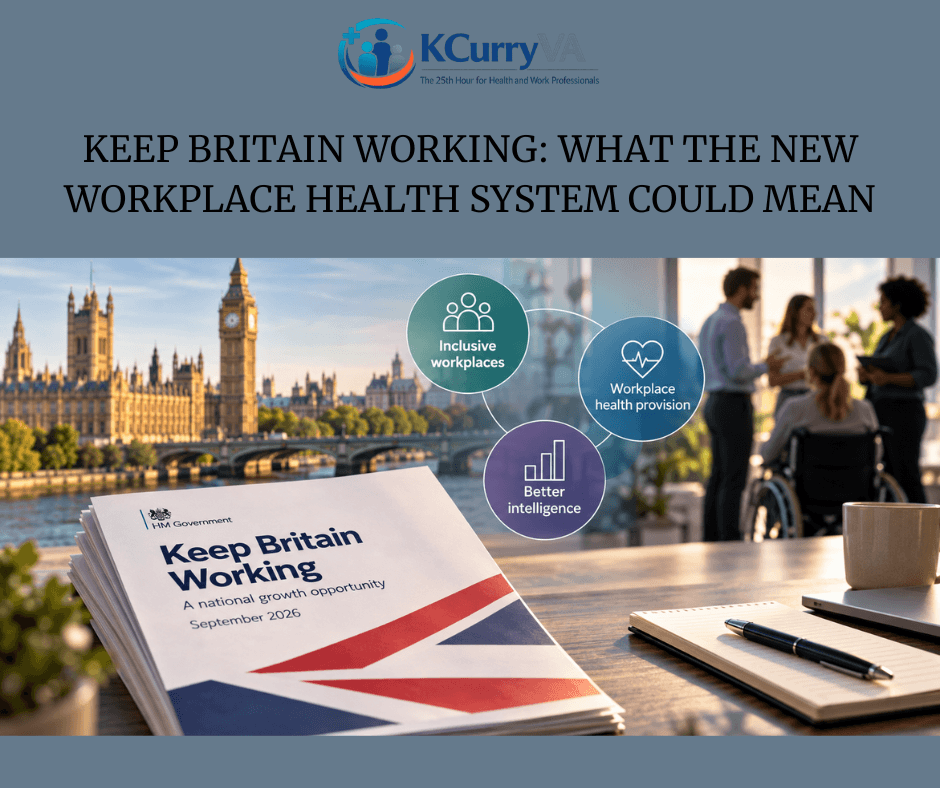
The latest Keep Britain Working update signals a shift towards earlier intervention, better retention and a more connected approach to workplace health
The latest Keep Britain Working update marks an important shift.
Published on 23 September 2026, the update sets out how recommendations from the independent Keep Britain Working review are now being taken forward, with a particular emphasis on building what is described as a Workplace Health System.
The scale of the issue is significant.
The government says around 300,000 people with a health condition leave work each year, while the number of working-age people out of work because of ill health has risen by approximately 800,000 since 2019.
The update argues that the opportunity is not simply to support people once they have left work, but to improve the way health and work are managed before work is lost.
For anyone working in occupational health, vocational rehabilitation, case management, occupational therapy, workplace wellbeing or related areas, that raises a more practical question:
What could this actually mean for the way workplace health and vocational rehabilitation are delivered?
Table of Contents
Key Takeaways
- The September 2026 Keep Britain Working update moves the programme from review towards testing and implementation.
- The proposed Workplace Health System has three components: better, more inclusive workplaces; better workplace health provision; and better intelligence on workplace health and inclusion.
- The proposed model places greater emphasis on earlier intervention, staying in work and sustained return to work.
- Workplace Health Provision is intended to be more coordinated, with case management, advice and guidance, early support and treatment, and employer insight working together.
- Better outcome data could eventually change how workplace health providers demonstrate the value of their services.
- The update does not prescribe a new operating model for independent practitioners, but it does point towards greater emphasis on coordination, accessibility, collaboration and measurable outcomes.
From Review to Implementation
The original Keep Britain Working review was published in November 2025.
The September 2026 update is different in tone and purpose.
It describes the work undertaken over the following ten months with employers, providers, places, unions and disabled people, and sets out the next phase of developing and testing the proposed Workplace Health System.
At its centre are three components:
- Better, more inclusive workplaces
- Better workplace health provision
- Better intelligence on workplace health and inclusion
These are intended to operate through a model of shared responsibility involving employers, employees, providers, places and government.
That is potentially significant because it moves the conversation away from workplace health as something that happens only after a problem has developed.
The stated ambition is to act earlier, support people to remain in work where possible, and improve the sustainability of returns to work.
See the government’s explanation of the proposed Workplace Health System.
The Intervention Window Matters
One of the most striking elements of the update is its emphasis on when intervention happens.
The government says that someone absent from work for four to six weeks has a 96% chance of returning. After a year, fewer than half return. It also reports that, once someone has become economically inactive because of health reasons, their probability of moving into work within a year is substantially lower than that of someone who is unemployed.
The important point isn’t simply the statistics.
It is what they imply about the role of workplace health professionals.
If the system is moving towards prevention, retention and earlier intervention, then the value of professional support isn’t confined to managing a case once someone is already on long-term absence.
It potentially begins much earlier.
That means recognising emerging difficulties, understanding the interaction between health and work, identifying what can be changed, and helping employers and employees have useful conversations before a situation becomes significantly harder to resolve.
This is already reflected in the proposed employer framework, which includes acting early to prevent issues, making it safer to raise concerns, making timely adjustments and agreeing practical stay-in-work plans.
A Bigger Role for Workplace Health Provision
The proposed system explicitly recognises providers as one of its core components.
The update describes providers as having responsibility for offering accessible, coordinated and work-focused support, with clear accountability and measurable outcomes.
It also recognises a problem that will be familiar to many people working across occupational health, vocational rehabilitation and case management:
The update describes a landscape involving occupational health, HR, employee assistance programmes, GPs, insurers, vocational rehabilitation and specialist treatment, with handovers between services often weak or absent.
Its proposed Workplace Health Provision model is intended to address that fragmentation.
The model includes four functions:
Advice and guidance
A trusted route to impartial, practical advice for employees and managers, including routes to further support.
Case management
An appropriately independent coordinator or case manager for more complex cases, helping to agree and monitor stay-in-work and return-to-work plans and connect other support.
Early support and treatment
Timely, evidence-based support for common work-limiting conditions and other issues that can affect someone’s ability to remain in work.
Employer insight
Aggregate information about recurring employee needs, workplace barriers and outcomes, allowing employers to improve workplace design and support.
The update makes clear that this model is not intended to replace clinical judgement, HR or line management. Instead, it is intended to provide coordination and additional support where those existing functions aren’t enough.
That distinction matters.
It suggests a model in which different professional disciplines continue to have their own expertise, but are better connected around the individual’s relationship with work.
The Data Question Could Be Particularly Important
This is perhaps one of the less immediately visible — but potentially significant — elements of the update.
The programme argues that employers currently have limited ability to compare how effectively they retain people with health conditions.
It also argues that providers cannot reliably compete on outcomes because comparable outcome data does not yet exist.
An employer data project is due to begin in autumn 2026, working with larger and smaller employers to explore whether existing organisational data can be collected consistently and proportionately.
The initial approach is intended to use information employers already hold rather than requiring them to redesign their reporting systems, and it will not initially require named or identifiable employee data.
The longer-term ambition is to develop better intelligence around measures including:
- sustained return to work
- health-related exits
- retention
- disability participation
- outcomes from workplace health support
That could eventually change the questions being asked of providers.
Not simply:
“How many people did you support?”
But:
“What happened afterwards?”
That is a significant shift.
It places greater emphasis on being able to understand whether support contributed to a meaningful and sustained outcome.
What Could This Mean for Independent Professionals?
This is where the update becomes particularly relevant to independent practitioners.
The September update does not announce a new requirement for independent practitioners.
Nor does it provide a definitive operating model for the sector.
It does, however, point towards several areas that may become increasingly important.
Earlier intervention
If the system increasingly prioritises prevention and retention, professionals may need to demonstrate the value of identifying and addressing work-related difficulties before they result in prolonged absence.
That reinforces the importance of understanding not just the health condition, but the interaction between the individual, their role and their working environment.
Joined-up support
The proposed model explicitly recognises shared responsibility.
Employers, employees, providers, places and government all have different roles.
For practitioners, this reinforces the importance of collaboration and communication across professional boundaries.
A good intervention doesn’t necessarily stand alone.
It may sit within a wider network of clinical, workplace and vocational support.
Outcomes
The programme is clearly interested in moving beyond activity and towards measurable outcomes.
For providers, that potentially means thinking carefully about what success looks like.
Is the objective simply completing an assessment?
Producing a report?
Making recommendations?
Or is the longer-term outcome whether someone remains in work, returns sustainably or experiences fewer barriers to participation?
The answer will vary according to the intervention and circumstances.
But the direction of travel is clear: outcomes matter.
Accessibility
The update also places considerable emphasis on making workplace health provision accessible to smaller employers.
It discusses pooled purchasing and other approaches that could make provision more affordable and accessible to SMEs and microbusinesses.
For independent practitioners, that could have implications for how services are packaged, accessed and communicated.
The opportunity may not simply be to provide a service.
It may increasingly be to make that service clear, accessible and demonstrably useful to the people and organisations purchasing it.
What Happens Next?
The next phase involves continued development and testing rather than immediate nationwide implementation.
The programme is working with employers and providers through Vanguards, alongside place-based partnerships, to test elements of the proposed system. The update says there are currently 11 regional Vanguards and more than 200 Vanguard organisations involved.
Examples include work in Liverpool City Region around return-to-work plans, pooled occupational health purchasing approaches for SMEs, and testing aspects of the proposed Workplace Health Provision model.
The programme is also working with the British Standards Institution on an employer-facing standard intended to provide clearer, outcome-focused expectations around workplace health.
The next phase will continue to test:
- the employer framework
- affordable and accessible Workplace Health Provision
- better workplace health intelligence
- place-based approaches
- how the emerging model could eventually be scaled
The programme intends to develop a route to wider adoption ahead of the 2027 Spending Review.
So this isn’t simply a policy document describing something that might happen eventually.
There is already testing and development activity underway.
The Question for the Profession
The most interesting part of the September update isn’t necessarily the scale of the economic figures.
It is the shift in emphasis.
The conversation is increasingly moving towards:
prevention rather than reaction
retention rather than simply return
earlier intervention rather than late escalation
coordination rather than fragmented support
outcomes rather than activity
That creates an opportunity — but also a challenge — for the professionals working within this space.
Because if workplace health is becoming a more integrated system, the question isn’t simply whether there will be more demand for workplace health services.
It is whether the profession is ready to demonstrate where its expertise fits within that system and what difference it makes.
For occupational health professionals, vocational rehabilitation practitioners, case managers, occupational therapists and others working at the intersection of health and work, that conversation is likely to become increasingly important.
And perhaps the most useful question to ask now is not:
“What will the Workplace Health System mean for my profession?”
but:
“What does my profession need to demonstrate, measure and do differently if this is the direction workplace health is moving?”
That is a conversation worth having now, while the system is still being developed and tested.
What Do You Think?
The development of a Workplace Health System could have implications across occupational health, vocational rehabilitation, case management, occupational therapy and the wider health and work profession.
What do you think it could mean for independent practitioners?
Where do you see the biggest opportunities — and where do you think the practical challenges might be?
I’d be interested to hear your perspective.
About KCurryVA
KCurryVA provides specialist operational support for health and work professionals, including case managers, vocational rehabilitation providers, occupational therapists and independent practitioners.
Through administrative, operational and project support, I help professionals reduce operational friction, protect valuable fee-earning time and create clearer, calmer and more sustainable ways of working.