
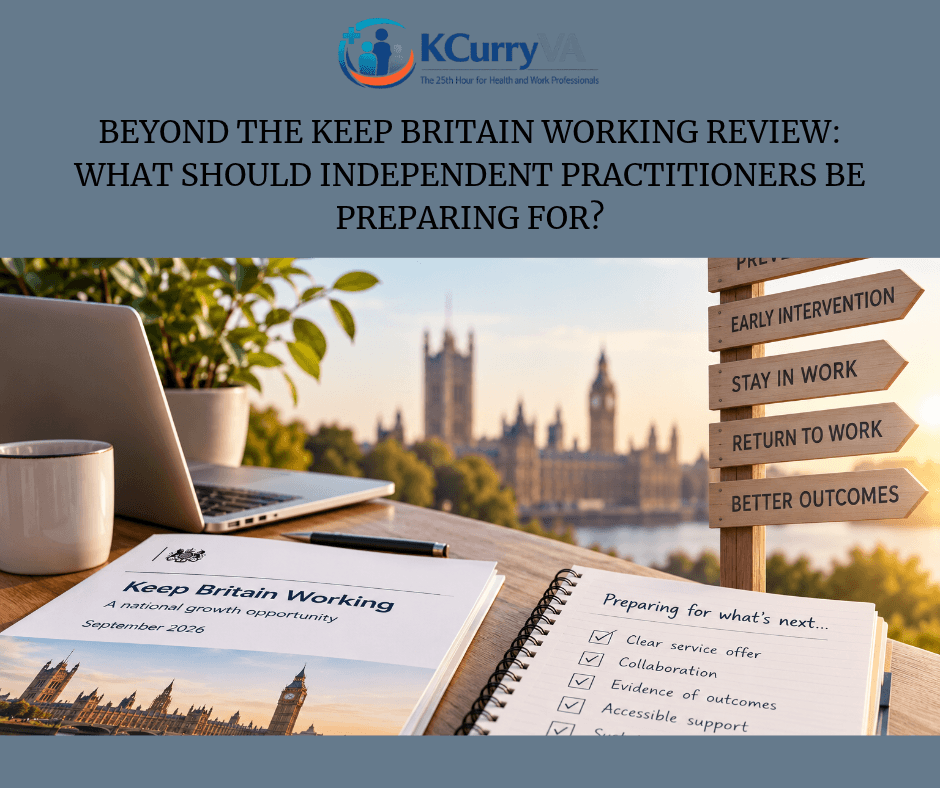
The conversation around workplace health in the UK is changing. There is growing emphasis on preventing ill health, supporting people to remain in work, improving return-to-work outcomes and making appropriate support more accessible.
The Government’s Keep Britain Working review is an important part of this shift. Its September 2026 update sets out plans for a more connected Workplace Health System, with an emphasis on healthier and more inclusive workplaces, accessible workplace health provision, and better intelligence about workplace health and inclusion.
If you haven’t already read it, my earlier article, Keep Britain Working moves from review to action: what the new Workplace Health System could mean for health and work professionals, provides an overview of the proposed changes and their potential significance for the sector
For independent practitioners working across health, rehabilitation, vocational rehabilitation and workplace wellbeing, this raises an important question:
How can you prepare for a changing professional landscape without waiting for every detail to be confirmed?
Table of Contents
The proposals are still developing, and it would be premature to assume that every change will translate into a new requirement for every independent provider. However, there are practical steps practitioners can take now to make their services clearer, strengthen collaboration and demonstrate the value of their work.
1. Make your service offer clear
The proposed Workplace Health System places greater emphasis on preventing avoidable work loss, taking action earlier and providing appropriate support to help people remain in or return to work. It also recognises the need for different types of support and better coordination between those providing it.
For independent practitioners, this raises a useful question: Can a potential client quickly understand what your service offers, who it is for and when it might be appropriate?
Specialist expertise is valuable, but prospective clients may not always know which service they need, when to seek support or how one type of intervention fits alongside another.
Consider reviewing your service descriptions and asking:
- What needs or challenges does each service address?
- Who is the service designed to support?
- When might a referral or intervention be appropriate?
- What can a client expect from the process?
- When might another professional or service need to be involved?
This is not about broadening your offer to cover everything. It is about explaining your expertise clearly and helping potential clients understand where it fits.
A well-defined service offer can also make conversations with employers, referral partners and other professionals more productive.
2. Think beyond individual referrals and towards collaboration
The Keep Britain Working updates identify fragmentation within workplace health provision as a challenge. People may need to navigate several different services, with gaps in communication and coordination between them. The proposed direction places greater emphasis on connecting support and making responsibilities clearer.
Independent practitioners do not necessarily need to build a multidisciplinary service themselves. However, they can consider how effectively they work alongside other professionals.
Effective collaboration depends on more than professional relationships; the processes behind communication, coordination and follow-up also shape the experience people have when accessing support. I’ve explored this further in What Happens When Administration Starts Affecting Client Experience.
For example:
- Do you know which other services might complement your own?
- Are there professionals you could collaborate with when someone’s needs extend beyond your specialism?
- Is it clear when you would refer someone elsewhere?
- Do you have an appropriate process for agreeing responsibilities and managing handovers?
- Can you explain how your service contributes to a wider support plan?
These questions are relevant across many areas of practice, from rehabilitation and employment support to occupational health, case management and specialist wellbeing services.
Collaboration also requires clear boundaries. Practitioners should remain within their competence, respect confidentiality and establish appropriate consent and information-sharing arrangements.
The opportunity is not to promise a seamless service that you cannot deliver. It is to understand where your work fits within the wider support landscape and make collaboration easier where appropriate.
3. Be ready to explain the outcomes of your work
The September update identifies better workplace health intelligence as a priority. It highlights gaps in consistent data, comparative evidence and understanding which interventions work, for whom and at what cost. The Government’s proposed direction includes more systematic measurement and learning about workplace health outcomes.
For independent practitioners, this makes it worth reviewing how you currently demonstrate the value of your services.
That does not mean every practice needs a sophisticated evaluation framework or an extensive set of performance indicators. It means being clear about what a successful intervention is intended to achieve and how progress will be assessed.
Depending on your specialism and the service being delivered, useful measures might include:
- Progress towards agreed functional, personal or workplace goals.
- Whether recommended adjustments or agreed actions have been implemented.
- Progress against an agreed rehabilitation, stay-in-work or return-to-work plan, where relevant.
- Feedback from the person receiving support or the organisation commissioning it.
- Completion of agreed actions and follow-up.
- Outcomes that can reasonably and ethically be attributed to your intervention.
Not every outcome will be directly within a practitioner’s control. Return to work, for example, can be influenced by an individual’s circumstances, workplace factors, management decisions and access to other support.
It is therefore important to distinguish between the work delivered, the progress observed and the wider outcome. Good reporting should demonstrate contribution without claiming more than the evidence supports.
Start with a simple question: if a client asked you what difference your service had made, what evidence could you provide?
If your answer currently relies mainly on describing the activities you completed, consider what additional information would help demonstrate progress and inform future decisions.
4. Review how accessible your services are
The proposed direction for workplace health provision includes improving access to appropriate support, with attention to early intervention and the needs of employers and employees. The programme also recognises the importance of making provision accessible and affordable for smaller employers.
For independent providers, accessibility is not solely a clinical or professional consideration. It can also affect how services are presented, commissioned and delivered.
Consider the practical experience of someone trying to engage your services:
- Can they understand your offer without needing an introductory conversation?
- Is it clear how to enquire or make a referral?
- Do you explain the likely process, timescales and costs?
- Are there unnecessary administrative steps before support can begin?
- Can you explain the options available, where appropriate?
It is also worth considering how you communicate with organisations that may have limited experience of commissioning specialist support.
An employer or organisation may recognise that someone needs help but be uncertain about which service is appropriate, what it will involve or how to justify the investment. Clear information can help decision-makers understand your service and determine whether it meets their needs.
Accessibility does not mean reducing the quality of your work or offering services at unsustainable prices. It means identifying avoidable barriers and making the route into appropriate support as straightforward as possible.
5. Make sure your business can support the work you want to deliver
There is a practical consideration behind all these changes: delivering clearly defined services, collaborating with other professionals and monitoring outcomes takes time and organisation.
As expectations evolve, practitioners may need to review not only their professional offer but also the systems supporting it.
For example, consider whether you have reliable processes for:
- Managing enquiries and referrals.
- Recording agreed actions and follow-up dates.
- Maintaining appropriate client records.
- Tracking the progress of projects or interventions.
- Producing reports for clients or commissioning organisations.
- Reviewing feedback and identifying opportunities to improve.
These processes do not need to be complicated. In many independent practices, a small number of well-designed systems will be more useful than a large collection of disconnected tools.
If your working week feels more reactive than you would like, my article on creating a more sustainable practice explores how reducing operational friction can help you move away from constant firefighting.
The aim is to make sure important information is accessible, commitments are followed through and the administrative demands of delivering work remain manageable.
It is also worth identifying which activities require your specialist expertise and which could be supported by better processes, technology or appropriate delegation.
That distinction can help protect time for the professional work your clients are paying for, while giving your business a stronger foundation for future development.
Preparing without waiting for every detail to be confirmed
The Keep Britain Working programme is continuing to develop its approach. Its September 2026 update describes further work on workplace health provision, the development of a proposed standard and a phased approach to wider adoption. The precise implications for individual practitioners will depend on how the proposals develop and how services are commissioned.
Independent practitioners do not need to predict every future requirement to take useful action now.
A sensible starting point is to review five areas:
- Your service offer: Is it clear who you support, what you do and when your expertise is appropriate?
- Your professional relationships: Do you know which other services or specialists you may need to work alongside?
- Your evidence: Can you demonstrate progress and explain the value of your work?
- Your accessibility: Is it straightforward for appropriate clients and organisations to understand and engage your services?
- Your operations: Do you have the processes needed to deliver work consistently and manage the associated administration?
You do not need to overhaul your entire practice at once. Choose the area where a review would make the greatest difference, identify one practical improvement and build from there.
The wider workplace health landscape is still developing. However, clarity, appropriate collaboration, credible evidence and reliable processes are valuable foundations for an independent practice, regardless of how the final arrangements evolve.
The question is not simply whether your practice is ready for the next policy change. It is whether your services and business operations are equipped to demonstrate their value, work effectively with others and respond to the needs of the people and organisations you support.
Sources and Further Reading
The following Government publications provide further information about the Keep Britain Working review, its recommendations and the development of the wider workplace health system.
Keep Britain Working: A national growth opportunity — September 2026
The Government’s latest update on the proposed direction for workplace health provision, including coordination, access and the use of evidence to inform decisions.
Keep Britain Working: The story so far — June 2026
Further context on the review’s development, the emerging approach to workplace health provision and the work taking place to progress its recommendations.