
Hidden inefficiencies that can quietly limit the capacity of an independent health and work practice
You don’t necessarily need more hours in your working week.
You may need fewer things getting in the way of the hours you already have.
For independent health and work professionals, a typical day can involve far more than client-facing work. There are reports to write, emails to answer, appointments to coordinate, information to chase, documents to find and follow-ups to remember.
None of these tasks are necessarily a problem.
The problem is what happens when the processes surrounding them become inefficient.
A missing piece of information delays a report. A diary change creates three more emails. A document is saved somewhere different from where you expected. A client needs an update, but you first have to work out where the relevant information is.
One small delay leads to another.
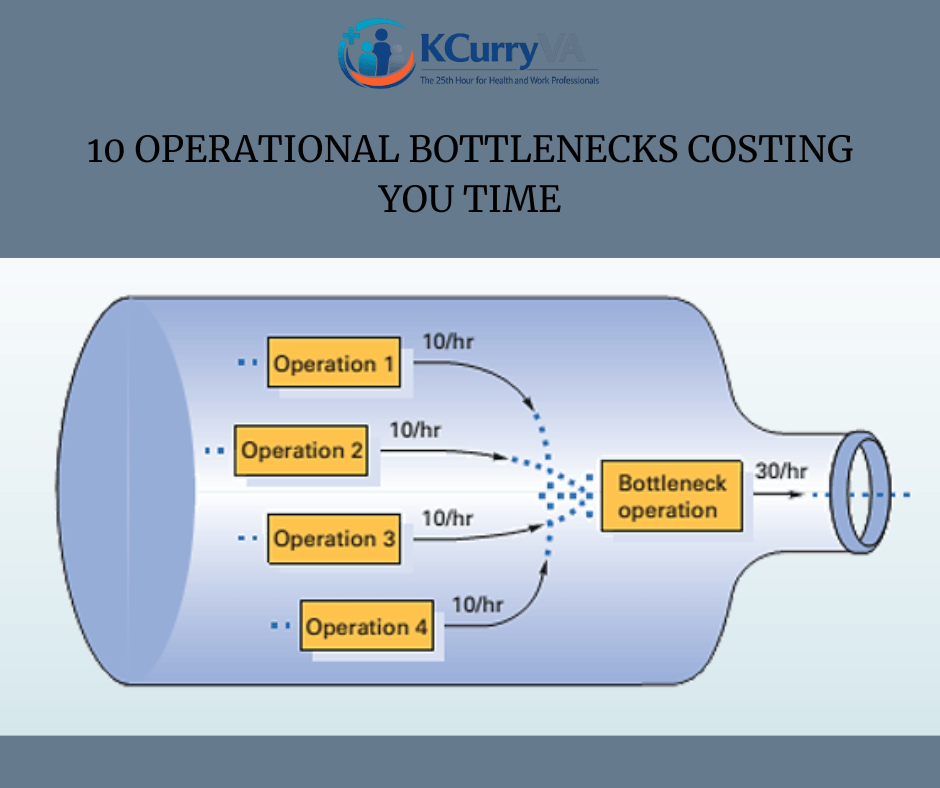
These are operational bottlenecks: points in a process where work slows down, becomes unnecessarily complicated or requires more of your time and attention than it should.
They can be surprisingly difficult to spot because you’re often too close to the process to see it objectively.
And when you’re already busy, the instinct is usually to work faster.
But faster isn’t always the answer.
Sometimes the better question is:
Where is the friction in the way I’m working?
In this article
Table of Contents
Key Takeaways
- Operational bottlenecks are often small points of friction that repeatedly slow your work down.
- The cumulative impact can be much greater than the time taken by any individual task.
- Not every bottleneck requires new software or a complicated system.
- Understanding where work gets stuck is the first step towards improving it.
- The goal isn’t to remove every administrative task; it’s to make sure your time and attention are being used where they create the greatest value.
What Is an Operational Bottleneck?
An operational bottleneck is a point within a process that limits how efficiently the work can move forward.
Think about a road narrowing from three lanes to one.
The cars haven’t changed.
The destination hasn’t changed.
But everything slows down because of the restriction.
The same thing happens in a practice.
You may have excellent clinical expertise, committed clients and plenty of demand, but if the operational processes supporting that work are inefficient, they can restrict how much you can comfortably manage.
Some bottlenecks are obvious.
Others are much harder to see because they have become part of your normal working routine.
Why Small Inefficiencies Matter
A ten-minute task isn’t necessarily worth worrying about.
But what happens when you do it several times a day?
Or when one ten-minute task creates another fifteen-minute task?
Or when an interruption means you need another twenty minutes to regain your concentration?
Operational friction compounds.
The real cost isn’t always the number of minutes involved.
It’s the combination of:
time + interruptions + decision-making + mental effort.
1. Chasing Information
Waiting for information can bring an entire process to a standstill.
You may be waiting for:
- medical information
- employer details
- HR contacts
- client documentation
- insurer information
- responses from another professional
The initial request may take two minutes.
The problem is remembering to follow it up, knowing when to follow it up and keeping track of what is still outstanding.
The bottleneck
Information is requested, but there isn’t a reliable process for monitoring what happens next.
Consider
Could you use standard request templates, a central tracker and consistent follow-up points?
The aim isn’t to chase people more efficiently.
It’s to remove the need to mentally remember who needs chasing and when.
2. Repeatedly Searching for Documents
How often do you find yourself thinking:
“Where did I save that?”
Perhaps information is spread across your inbox, computer, cloud storage and different client systems.
Finding one document may only take a few minutes.
But repeated searching creates interruptions throughout the day.
The bottleneck
Information exists, but isn’t consistently organised or easy to retrieve.
Consider
Could you establish a standard filing structure and naming convention?
The best filing system isn’t necessarily the most sophisticated.
It’s the one you can use consistently.
3. Managing a Constantly Changing Diary
Diary management can become surprisingly complex as a practice grows.
Appointments move.
Clients cancel.
New enquiries arrive.
Meetings need scheduling.
Reports need completing.
Suddenly, you’re spending significant time rearranging the diary rather than delivering the work within it.
The bottleneck
Your diary is being managed reactively rather than around defined rules and priorities.
Consider
Could you establish clearer appointment parameters, communication processes and protected time for administrative work?
4. Repeating the Same Emails
If you regularly write variations of the same messages, you’re probably spending time recreating something you’ve already solved.
Appointment confirmations.
Information requests.
Follow-ups.
Meeting arrangements.
Routine updates.
The bottleneck
A repeatable communication process is being handled as a new task every time.
Consider
Create a library of approved templates that can be adapted when necessary.
Templates shouldn’t make communication impersonal.
They simply remove the need to start from a blank page.
5. Starting Reports From a Blank Page
Complex reports require professional judgement.
The structure surrounding that judgement doesn’t necessarily need to be reinvented every time.
If you’re repeatedly deciding:
- what headings to use
- how to structure information
- how to phrase routine sections
- where particular information belongs
then part of your cognitive capacity is being spent on the process rather than the professional thinking.
The bottleneck
The report-writing process isn’t sufficiently structured.
Consider
Could a modular template provide the framework while leaving the clinical reasoning entirely with you?
The objective isn’t to make every report identical.
It’s to make the process of producing a high-quality report more consistent.
6. Keeping Everything in Your Head
This is one of the least visible—and potentially most expensive—bottlenecks.
You remember:
- who needs a call
- which report is due
- what information is outstanding
- when an appointment needs rearranging
- which invoice hasn’t been sent
- what you promised someone last week
Your brain becomes the task management system.
The bottleneck
Important information and actions aren’t consistently externalised.
Consider
Use one trusted system for outstanding actions and deadlines.
The objective isn’t perfect organisation.
It’s reducing the number of things your brain has to remember.
7. Switching Between Too Many Systems
You start the morning in your email.
Then your calendar.
Then your client management system.
Then an insurer portal.
Then your documents.
Then back to email.
Each system may be necessary.
The problem is the constant movement between them.
The bottleneck
Information and actions are fragmented across multiple platforms, creating repeated context switching.
Consider
Look at which systems genuinely need to be used and whether information can be consolidated, linked or accessed more efficiently.
You may not be able to eliminate every platform.
But you can reduce unnecessary movement between them.
8. Following Up Without a Clear Process
Follow-up is essential in many professional practices.
But if every follow-up relies on memory, sticky notes or searching through old emails, it becomes another source of cognitive load.
The bottleneck
There is no consistent process for tracking what happens after an interaction.
Consider
Create defined follow-up points and a simple system for recording the next action.
The important thing is that the process tells you what needs attention rather than relying on you to remember it.
9. Doing Tasks in the Wrong Order
Sometimes the problem isn’t the task itself.
It’s when you do it.
For example, you might begin writing a report only to realise that key information is missing.
You stop.
You send a request.
You return to the report later.
You then have to remind yourself where you were.
The task has now become much more expensive in terms of time and attention.
The bottleneck
The workflow doesn’t prevent avoidable stops and starts.
Consider
Look at the sequence of your processes.
Is there information that should always be collected before a particular task begins?
Could certain steps be completed together?
A better sequence can sometimes remove an entire layer of friction.
10. Trying to Manage Everything Yourself
This may be the biggest bottleneck of all.
When you’re responsible for every part of the practice, every operational issue eventually comes back to you.
You are the person who:
- notices the problem
- decides what needs doing
- remembers to do it
- completes it
- checks it
- follows it up
Even relatively simple processes become mentally expensive when one person owns every stage.
The bottleneck
Responsibility for operational work sits almost entirely with the practitioner.
Consider
Ask:
Does this task require my professional expertise, or does it simply require someone to take ownership of it?
That distinction matters.
Delegation isn’t about handing away control.
It’s about making sure the right work sits with the right person.
How to Identify Your Own Bottlenecks
You don’t need to redesign your entire practice to find out where your problems are.
Start by observing.
For one working week, notice whenever you:
- have to stop and wait
- search for information
- repeat something unnecessarily
- switch between systems
- chase someone
- make the same decision repeatedly
- remember something that isn’t recorded anywhere
- restart a task after an interruption
You could simply keep a running note on your phone or computer.
At the end of the week, look for patterns.
You may find that the same bottleneck appears repeatedly.
That’s where your attention should go first.
What To Do Once You’ve Found a Bottleneck
Finding a problem doesn’t mean you immediately need new software, a complicated workflow or additional staff.
Work through the simplest options first.
1. Remove it
Is the task actually necessary?
2. Simplify it
Can you reduce the number of steps?
3. Standardise it
Could a template, checklist or defined process make it more consistent?
4. Automate it
Is there technology that can reliably handle part of the process?
5. Delegate it
Does someone else need to own this task?
This order matters.
There is little point automating a process that shouldn’t exist in the first place.
Five Questions to Ask About Your Practice
Take a look at your own working week and ask:
- Where does work most often get stuck?
- Which task do I repeat more than I should?
- What do I regularly have to chase?
- What information takes too long to find?
- Which operational task would I most like someone else to own?
The answers will give you a much clearer picture of where your practice is losing time.
And once you can see the bottlenecks, you can start deciding what needs to change.
A Final Thought
Operational efficiency isn’t about squeezing more work into every available minute.
It’s about removing unnecessary friction from the way work moves through your practice.
Some bottlenecks will be small.
Some will require more significant changes.
And some may simply reveal that there is more operational responsibility sitting with you than one person should reasonably be expected to carry.
The important thing is to stop treating every delay, interruption or repeated task as an inevitable part of running your business.
Sometimes it is.
Sometimes it isn’t.
The first step is noticing the difference.
Because when you remove the friction surrounding your work, you don’t just gain time.
You create more capacity for the work that genuinely requires your expertise.
About KCurryVA
KCurryVA provides specialist operational support for health and work professionals, including case managers, vocational rehabilitation providers, occupational therapists and independent practitioners. Through administrative, operational and project support, I help clients reduce operational friction, protect valuable fee-earning time and create clearer, calmer and more sustainable ways of working.