
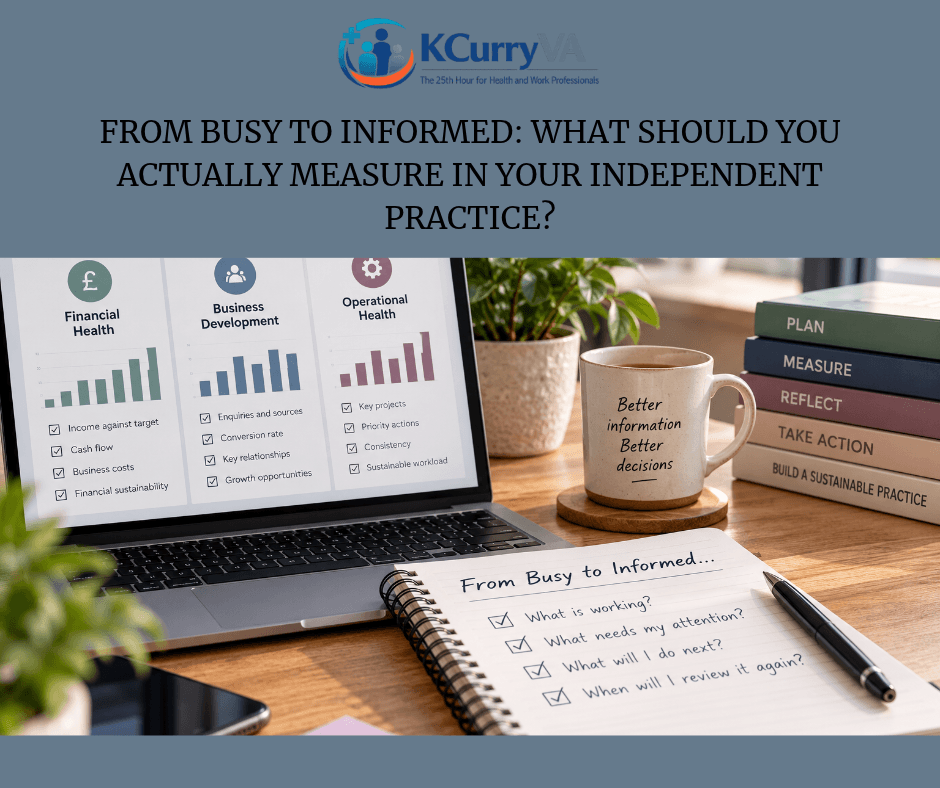
Running an independent practice involves far more than delivering your professional service. Alongside client work, there are enquiries to manage, relationships to maintain, finances to monitor, professional development to undertake and decisions to make about the future of your business.
When you’re balancing all these responsibilities, it can be difficult to step back and assess how well your practice is actually performing.
You might know how much work you’ve completed this month, how many hours you’ve worked or how busy your diary has been. But do you know whether your business is financially sustainable, which activities are generating opportunities or whether you’re making progress towards your longer-term goals?
Being busy tells you how much you’re doing. Measuring your business helps you understand whether what you’re doing is working.
Table of Contents
You don’t need a complicated reporting system or dozens of performance indicators to gain a clearer picture. You need a small number of meaningful measures that help you make informed decisions about your practice.
Here are three areas worth reviewing.
1. Financial health: Is your practice working for you?
It’s easy to use income as the main indicator of business performance. If you’ve had a good month financially, it can feel as though things are going well. If income has fallen, it can feel as though something needs to change.
However, income alone doesn’t tell the whole story.
A practice can generate a healthy turnover while still experiencing cash-flow difficulties, carrying high costs or requiring more of the owner’s time than is sustainable.
Instead of looking at income in isolation, consider the wider financial picture.
Income against target
Do you have a realistic income target for your business, and are you reviewing your progress against it?
Comparing actual income with your target can help you identify patterns. If you’re consistently falling short, you may need to review your pricing, available capacity, business development activities or the mix of services you offer.
If you’re regularly exceeding your target, that also raises useful questions. Is the increase sustainable? Are you working longer hours to achieve it? Is there an opportunity to improve how you deliver your services?
The aim isn’t simply to achieve a particular figure. It’s to understand what is driving the result.
Cash flow and financial commitments
Income recorded on an invoice isn’t necessarily money available to spend today.
Understanding when money comes in and when expenses need to be paid helps you plan ahead, prepare for quieter periods and identify potential problems before they become urgent.
Consider whether you know:
- What your essential monthly business costs are.
- How much income you need to cover those costs.
- Whether outstanding invoices are affecting the money available to you.
- What financial commitments are coming up.
- Whether your current income supports the level of pay you need from the business.
If you haven’t reviewed your cash flow recently, this is a useful place to start.
What your financial measures should tell you
The value of tracking financial information lies in what you do with it.
If income is below target, for example, the answer isn’t automatically to increase marketing activity. You may need to understand whether you have enough suitable enquiries, whether those enquiries are converting into work or whether your current capacity is limiting what you can deliver.
The question to ask is: what is my financial information telling me about the decisions I need to make?
2. Business development: Which activities are creating opportunities?
Independent practitioners often develop their businesses through a combination of referrals, networking, professional relationships, speaking opportunities, website enquiries and other marketing activities.
The challenge is knowing which activities deserve your time and attention.
You might attend several networking events, publish regularly on LinkedIn or spend time developing professional relationships. Those activities can all have value, but the amount of activity alone doesn’t tell you whether your approach is effective.
Rather than simply counting what you’ve done, consider tracking what happens as a result.
Where are your enquiries coming from?
Start by recording where new enquiries originate.
For example, an enquiry might come from:
- A professional referral.
- A networking contact.
- A speaking engagement.
- Your website.
- LinkedIn or another professional platform.
- A previous client or existing relationship.
Over time, this information can help you identify which channels are generating relevant conversations.
You may discover that one professional relationship produces regular referrals, while another activity generates visibility but very few suitable enquiries. Alternatively, you might find that a particular type of speaking opportunity introduces you to organisations you would not otherwise reach.
The important point is to assess the quality and relevance of the opportunities, not just their quantity.
Are enquiries turning into work?
An enquiry is not the same as a new client.
Tracking how many enquiries progress to a discovery call, proposal or paid engagement can help you understand where opportunities are progressing and where they are stalling.
If you receive plenty of enquiries but few convert, you may need to review how clearly you communicate your offer, whether you’re reaching the right audience or whether your service meets the needs of the people contacting you.
If enquiries are limited but most convert into work, the issue may be attracting more suitable opportunities rather than changing your sales process.
These are different problems requiring different responses.
Are your relationships developing?
Not every valuable professional relationship will lead directly to paid work.
Some provide industry insight, peer support, collaboration opportunities or access to people and organisations you may work with in the future.
This is particularly important in professions where trust, reputation and professional credibility influence how relationships develop.
You don’t need to assign an immediate financial return to every conversation. Instead, consider whether your networking activities are helping you build the relationships you intended to develop.
The question to ask is: which business development activities are worth continuing, and what evidence supports that decision?
3. Operational health: Is your business moving in the right direction?
Financial results and business development activity are important, but they don’t tell you everything about the health of your practice.
You also need to understand whether the business is operating effectively and whether you’re making progress towards the goals you’ve set.
This is where operational measures become useful.
Are your priorities progressing?
Most independent practitioners have projects or improvements they want to work on alongside their client commitments.
Perhaps you want to review your service offer, improve your website, develop a new resource or establish a more consistent approach to business development.
These activities can easily be postponed when client work takes priority.
Tracking a small number of important projects and actions helps you see whether your plans are progressing or repeatedly being pushed aside.
You don’t need an elaborate project management system. A simple record of your priorities, next actions and progress may be enough to identify where things are getting stuck.
Are you following through on important activities?
Consistency matters in many areas of running a business.
You might intend to follow up with prospective clients, maintain professional relationships, review your finances or complete regular business development activities. If these commitments are not tracked, they can become inconsistent when your workload increases.
Recording whether important actions have been completed helps you distinguish between having a plan and putting that plan into practice.
If an action repeatedly remains incomplete, the answer may not be to try harder. You may need to reconsider the timing, reduce the scope, change the process or allocate the task differently.
Is your business becoming more sustainable?
Operational health also involves looking at how the business affects your capacity.
Consider whether you’re able to deliver your services without routinely working beyond your intended hours, whether recurring tasks are becoming easier to manage and whether the business can maintain essential activities during busy periods.
You might track a few practical indicators, such as:
- Whether planned business development activities are taking place.
- Whether important projects are progressing.
- Whether key administrative actions are completed on time.
- Whether recurring operational problems are being resolved.
- Whether your current workload is compatible with your available capacity.
These measures won’t tell you everything about your business, but they can highlight issues that income figures alone might not reveal.
The question to ask is: am I building the practice I intended to build, or am I simply keeping up with what needs doing today?
The mistake to avoid: measuring everything
Once you start considering what to measure, it can be tempting to track everything.
You could monitor website visits, social media engagement, networking conversations, hours worked, enquiries, proposals, income, expenses, projects and dozens of other indicators.
Some of these measures may be useful. Others may create work without helping you make better decisions.
The purpose of measuring business performance isn’t to produce the largest possible collection of data. It’s to identify the information that helps you understand your business and decide what to do next.
For example, knowing how many people viewed your latest LinkedIn post might be interesting. Understanding whether your LinkedIn activity is helping you reach the people you want to work with may be more useful when deciding where to invest your time.
Similarly, recording how many hours you work can help you understand your workload. Comparing your available capacity with the work you need to deliver may tell you more about whether your current business model is sustainable.
Every measure should have a purpose. If you cannot explain what a figure helps you understand or what decision it might inform, consider whether you need to track it.
A practical starting point: Choose three measures
You don’t need to overhaul your reporting or spend weeks building a dashboard.
Start by selecting one useful measure from each of the three areas covered in this article.
| Area | Example measure | What it helps you understand |
|---|---|---|
| Financial health | Actual income against monthly target | Whether your income is progressing as planned. |
| Business development | Number of suitable enquiries and their sources | Which activities are generating relevant opportunities. |
| Operational health | Progress against your three most important business priorities | Whether you’re making progress beyond day-to-day delivery. |
These are examples rather than a prescribed set of indicators. Your measures should reflect the nature of your practice, your current priorities and the decisions you need to make.
Once you’ve selected them, use the following questions to make your review more meaningful:
1. What happened?
Record the result without immediately judging it.
2. What does it tell me?
Consider the possible reasons behind the result. Is it part of a wider pattern, or could there be a one-off explanation?
3. What needs my attention?
Identify whether the result requires further investigation or action.
4. What will I do differently?
Choose a practical next step, where one is needed.
5. When will I review it again?
Set a date to check whether the action has made a difference.
For most independent practitioners, a monthly review is a reasonable starting point for many business measures. Some information, particularly cash flow, may need more frequent attention depending on your circumstances.
The important thing is to establish a review routine you can maintain.
From information to better decisions
Measuring your practice is not about turning every aspect of your business into a number. Nor is it about comparing your performance with someone else’s business, which may have different services, costs, priorities and capacity.
It’s about understanding your own practice well enough to make informed decisions.
That might mean recognising that an activity isn’t generating the opportunities you expected, identifying a financial concern earlier, protecting time for an important project or deciding that your current workload leaves too little capacity for business development.
It can also help you recognise what is working, so you can continue investing in the activities that support your goals.
Over time, a consistent review process gives you a clearer picture of how your practice is performing and whether your decisions are moving you in the right direction.
You don’t need perfect data to begin. You need useful information, an honest assessment of what it tells you and a willingness to act on what you learn.
A final question to consider
If you had 30 minutes at the end of this month to review your practice, what information would you want in front of you?
Start there.
Choose a few measures that matter, review them consistently and use what you learn to decide what deserves your attention next.
Because the goal isn’t simply to run a busy practice. It’s to build a practice that works for you, supports the people you serve and can develop sustainably over time.
Sources and further reading
I’d include a short source section at the end of the published article. These are useful, credible resources for readers who want to explore business performance and financial management further:
- Monitor business performance and plan for growth — Westminster City Council — practical guidance on reviewing performance, monitoring finances and making informed business decisions. Westminster City Council
- Setting up business accounting and finance — Business.gov.uk — guidance on maintaining financial records and understanding business finances. Business Growth Service
- A guide to financial management for SMEs — GOV.UK — further information on financial management through different stages of business development. GOV.UK
These sources support the general principles in the article; the suggested measures and review questions are practical recommendations tailored to independent practices rather than requirements prescribed by those sources.